[…]
Read More… from Optimo Project – New Recycling Regulation in Flanders

The LIFE DOP project (Demonstrative mOdel of circular economy Process in high quality dairy industry) is a EU project, located in Mantua district, in the middle of the cheese production chain, aiming to demonstrate a new production model for Grana Padano PDO (Protected Designation of Origin) and Parmigiano Reggiano PDO, able to reduce the environmental impacts of production. As literature clearly outlines, (Thoma et al., 2012, IPCC 2006) a relevant area of GHG emission in milk production is the management of slurry and of nutrients, and these are key areas in which is important to invest to reduce burdens. […]
ReNu2Farm aims to increase recycling rates of the main plant nutrients, N, P and K, by focusing on the demand of farmers. A study carried out within ReNu2Farm in 2019 under the lead of researchers from NMI (NL) and CIT Cork (IRE) is now published online and in full length. The work was previously presented at several meetings and conferences (e.g. ManuResource 2019 and recently at the International Fertiliser Society Webinar) where it received great interest from stakeholders, in particular policy makers and producers of recycling-derived fertilisers. […]
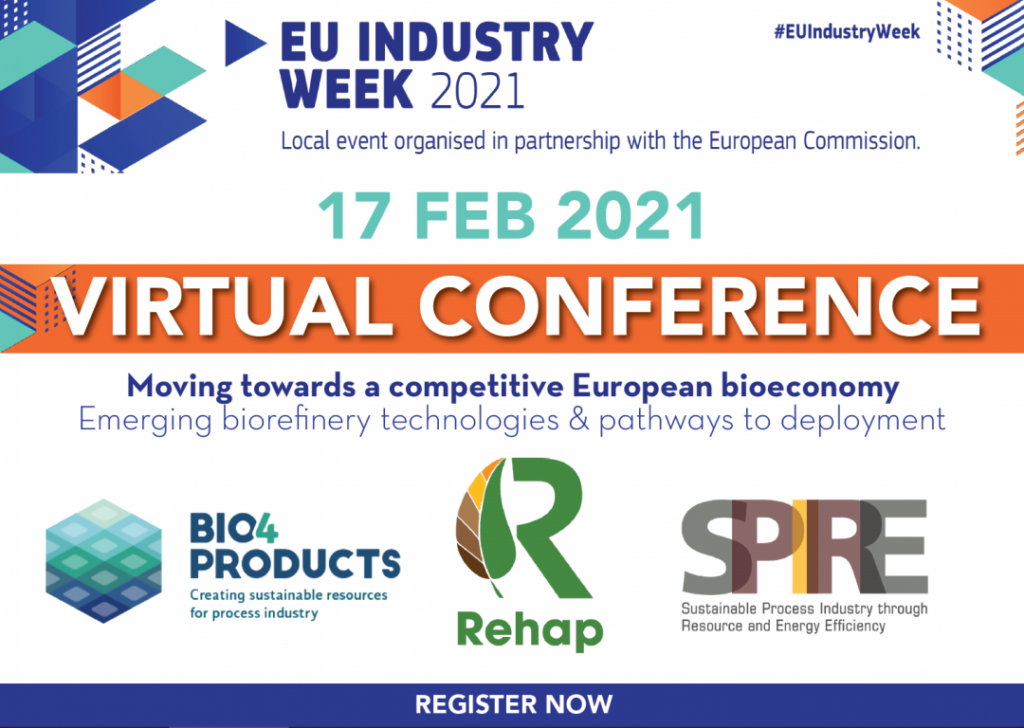
Virtual Conference – Moving Towards a Competitive European Bioeconomy:
Emerging Biorefinery Technologies & Pathways to Deployment, 17 February 2021 […]
Run4Life is an EU project focused on recovering fertilisers from source-separated domestic wastewaters and kitchen waste. A consortium of technology provides, end users, universities, public utilities and social sciences experts work together to innovate and apply technologies at four full scale demonstration sites in Europe: Nieuwe Dokken in Ghent (BE), Oceanhamnen in Helsingborg (SE), Lemmerweg in Sneek (NL) and Porto do Molle in Vigo (ES). The consortium works on technology and product development and on the integration and success of the new concepts in society through for instance social and market acceptance. At the sites different combinations of technologies and products are demonstrated. […]
Research on the management, treatment and up-cycling of bio-waste into valuable bio-based fertiliser products is currently one of the hot topics in the Bioeconomy sector. […]
Run4Life is an EU project focused on recovering fertilisers from domestic wastewaters and kitchen waste. By separating toilet-wastewater (black water), other domestic wastewater (grey water) and kitchen waste at the source, nutrients can more efficiently be recovered. With the technologies applied in Run4Life the nutrients from the toilet-wastewater and kitchen waste are safely converted into fertiliser products. In 4 cities in Europe this concept is applied at full scale in different configurations. […]
Read More… from ‘Fertilisers from wastewater’ an award winning concept
A Swansea University team has published a new article, detailing a novel approach to reuse food and farm waste at an industrial scale, using microalgae.
The paper explains the ways in which algae can be cultivated using excess nutrients, the optimum two-step approach used to maximise productivity, and how this biomass is optimally suited for use as an animal feed ingredient. […]
Read More… from Using waste nutrients to cultivate microalgae – Swansea team publishes new report
Within Phos4You, the Environmental Research Institute, Scotland has been developing the FILTRAFLOTM-P reactor together with Veolia, France to recover P from wastewater through a filtration/adsorption process. […]
The INTERREG NWE project Phos4You demonstrates about 7 different technologies for P-recovery from waste water. The technology processes are set up at the partner’s locations, partly at urban waste water treatment plants, partly at rural locations depending on the territorial context. For each technology a short video is made to show challenges and implementation of different solutions. […]
Read More… from Phos4You Videos: Phosphorus recovery from waste water
The ReNu2Farm project aims to increase the use of recycling-derived fertilisers such as composts, ammonium salts, mineral concentrates, digestates, and struvite. This will reduce the use of non-renewable rock phosphate and energy-intensively produced mineral nitrogen fertilisers. For farmers, knowledge of the agronomic value of a fertiliser is crucial. The agronomic value comprises above all, the nutrient value: How high is the nutrient content, and how plant-available are these nutrients? Other aspects are the lime as well as the organic matter value. Also, farmers need to be sure that the fertiliser product is safe and does not contain pollutants such as heavy metals or pathogens. […]